Racine County votes on its tax levy tonight. Human services is the biggest cost, and most of the money
The Racine County Board votes tonight on the property-tax levy that pays for the 2027 budget it adopted Nov. 2: $68.8 million, up 3.8% from this year.
The Racine County Board votes tonight on the property-tax levy that pays for the 2027 budget it adopted Nov. 2: $68.8 million, up 3.8% from this year. The board meets at 6:30 p.m. at the Ives Grove Office Complex, 14200 Washington Ave., Sturtevant, and the meeting is streamed on the county’s YouTube channel. The levy resolution is on the agenda, County Clerk Wendy Christensen said Monday.
The single largest piece of that budget is human services. The county plans to spend $74.9 million on it in 2027, about 28 cents of every dollar in the budget. But human services takes only about 17 cents of every levy dollar, because most of what pays for it comes from state and federal programs and from billing for services. That gap between what the work costs and what local taxes cover is where the pressure sits, and it is the part of the budget most exposed to decisions made in Madison and Washington rather than at Ives Grove.
“The state is not giving us the amount that’s actually required for the services mandate,” Human Services Director Hope Otto told the county’s Health and Human Development Committee on Monday night. The state takes its own administrative share out of federal money first, she said, “and then pass[es] through whatever’s remaining to the counties. So in general, irrespective of the division or department or the program, we find that we are underfunded in most areas.”
Supervisor Robert N. Miller, the committee’s vice chairman, said the staff the budget adds will not land on property taxpayers the way critics assumed during the budget debate.
“This is additional staff, but it’s additional staff that’s going to be covered by insurance and by government programs from state and federal,” he said. “I think the challenge for us as supervisors and staff is to continue to tell that story, because I don’t think it’s out there yet.”
Supervisors adopted the budget 15–4 on Nov. 2 without amendments, the county said in a Nov. 9 response to Racine County Eye. The county says it will post the adopted budget book after the levy vote.
“We kept the levy increase, which is what matters to the taxpayers, to 3.8 percent,” Malicki told supervisors at the Nov. 2 meeting. Supervisor Ernie Rossi of District 7, one of the four no votes, said the test was different. “A budget is judged by whether we can afford it this year and in the years that follow,” he said. “On that test, I cannot support this budget.”
What your county tax dollar pays for
The levy is the part of county spending that comes from property-tax bills. The county’s 2027 budget totals $270.3 million; the levy covers $68.8 million of it, and the rest comes from the state and federal governments, the half-percent county sales tax, fees, charges and borrowing.
Where the levy goes is not where the spending goes. Criminal justice and the courts, including the jail and the Sheriff’s Office, are budgeted at $60.1 million but take $46.1 million of the levy—two-thirds of it—because little outside money pays for a jail. Human services is budgeted at $74.9 million but takes $11.5 million of the levy, according to the budget book’s summary of spending and levy by function.
The county’s general countywide levy rises from $62.7 million to $65.1 million, with the remaining $68.8 million going to the Prairie Lakes Library System and county schools. Because property values rose, the countywide rate falls to $2.470 per $1,000 of equalized value, and the county estimates its share of the bill on a $250,000 home at $617, down from $620. What any one owner pays depends on that property’s value and on the schools, municipality and technical college that share the bill.
Why human services costs more every year
Racine County spending on human services, counting the Human Services Department, public health, the medical examiner, veterans services and related offices, has grown from $58.3 million in the 2023 budget to $74.9 million in 2027, a 29% increase over four budgets. Staffing in that group rises from 417 to 437 full-time-equivalent positions in 2027, and personnel costs rise 10.5% to $41 million.
The budget book names the drivers: “continued cost increases for high-cost care including psychiatric hospitalizations, residential treatment, juvenile corrections, and other placements.” Those are costs the county largely cannot refuse. State law requires counties to provide child protection, mental-health commitments, juvenile justice and public-benefit administration whether or not the money arrives to cover them.
Otto’s answer Monday came in response to a supervisor’s question about why Wisconsin ranks near the bottom of the states in public-health spending. Racine County has a second complication, she said: two separate public health departments—the county’s and the City of Racine’s—each funded under its own formula.
Dr. David Galbis-Reig, the Ascension addiction-medicine physician who works with the county’s programs, told the committee the same night why residential treatment in particular lands on local budgets. He compared it to the rehabilitation stay an insurer pays for after a broken hip. “In addiction treatment, the comparable level of care would be a residential treatment program,” he said, but federal rules “don’t permit room and board payments for addiction, and that’s part of stigma.” Medicaid and Medicare, he said, do not pay for it: “That’s my population. That’s 90% of the patients I treat.”
How the department covers the gap
The Human Services Department itself, the largest part of that group, budgets $68.3 million in spending for 2027, up $3.4 million, or 5.2%, from the original 2026 budget. It expects $60.3 million in revenue before reserves: $49.8 million from other governments, $9.6 million in charges for services, and smaller amounts from fees and donations. Property taxes cover $7.74 million, up $245,495, or 3.3%. Planned use of reserves falls from $1 million to about $292,000.
County Executive Ralph Malicki’s written budget address credits two things for that: cheaper ways of meeting mandates, including Lake Behavioral Health as an alternative for mental-health commitments, and better billing.
“We’re also doing a better job of capturing outside revenue through billing, grants, and reimbursement,” he wrote. “Instead of relying on reserves to close the gap, we are improving how we do business.”
One change is new in 2027. The county will begin budgeting what it calls “agency management, support and overhead” revenue, earned by charging up to 15% of administrative costs against state and federal grants. The budget says that money was previously unbudgeted and “a large component of Human Services Fund budget surplus each year.” The budget does not say how much the department expects to collect; Racine County Eye has asked.
Malicki made a sharper version of Miller’s point Monday night. “Our human services department’s impact to our taxpayer is less than half of what Kenosha’s is, and we do the work in-house,” he told the committee. Racine County Eye has not compared the two counties’ budgets and cannot confirm that figure.
The department’s own 2026 numbers show how much the mix can move. By the county’s year-end estimate, Human Services will spend about $38.8 million on personnel in 2026, roughly $4.9 million more than it budgeted, and about $21.7 million on purchased services, roughly $5.1 million less than budgeted. The budget book does not explain the shift, and an estimate is not a final figure.
What the 2027 money buys
The youth center. The department’s county staffing rises from 376 to 395 full-time-equivalent positions. Ten of the new positions are youth-development staff meant to increase supervision in the dayrooms at the Jonathan Delagrave Youth Development and Care Center, and medical coverage there goes from 12 to 16 hours a day.
“A facility built for rehabilitation requires adequate staff,” Malicki wrote. “Every unfilled position means a gap in supervision and programming.”
He said proper staffing would let the county keep more young people in Racine County rather than placing them in facilities hours away. Budgeted positions are not filled positions, and the budget does not say whether the added hours have begun.
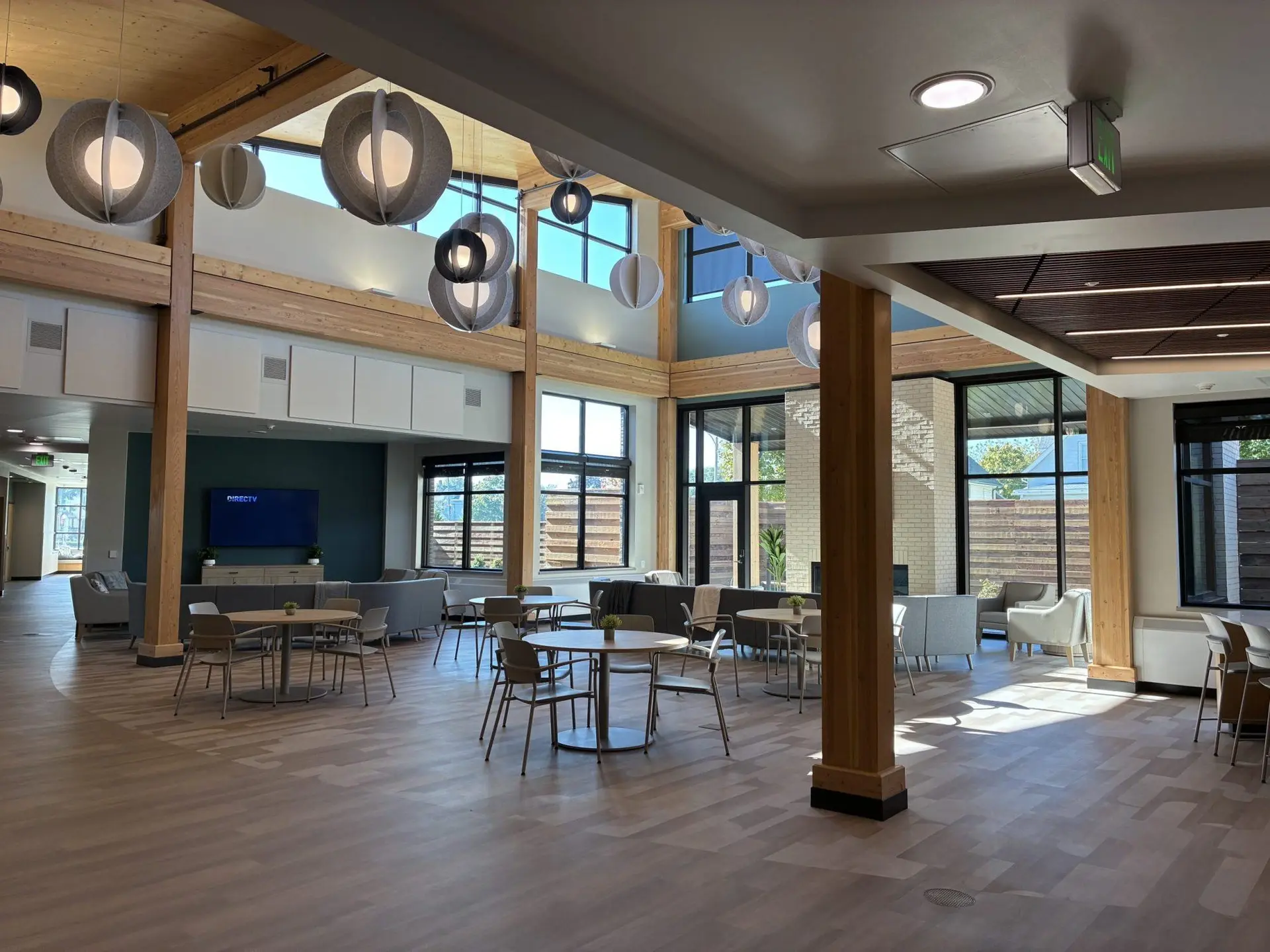
The Behavioral Health Building. The county opened its new building at 1720 Taylor Ave. on Oct. 21. It houses crisis services, case management and what the county describes as a 15-bed residential substance-use treatment program.
Galbis-Reig told the committee that Racine is “the only county that I’m aware of” among Wisconsin’s 72 “that actually has its own residential treatment program,” and that counties this size usually contract that work out. “Don’t expect dividends in a year or two,” he said. “It’s a five- to 10-year turnaround when you put programs like this together to see the effects.”
Debt payments on the building begin in the 2027 budget at about $1.67 million a year; the county applies $418,485 of opioid settlement money against them. Racine County Eye asked the county Monday night whether the residential unit has begun admitting people, on what date, how many of its 15 beds are filled and who receives the $600,000 in rent budgeted for the program. The county’s media office said Tuesday morning it would respond; this story will be updated when it does.
Meals on Wheels. The budget uses levy dollars to cover the remaining cost of Home Delivered Meals after other revenue, as Racine County Eye reported in October. Jelena Jones, the county’s behavioral health administrator, told the committee Monday that the money—close to $200,000—lets the program keep serving every eligible person five days a week with no delay, and asked that the item come off the committee’s standing agenda.
Public health. The county’s Public Health Division asks for $1.74 million in levy support, up 7.4%, with no added staff; its 31.95 positions are unchanged. The increase comes mostly from purchased services, which rise 62%, to about $503,000, while the division also expects 19% more in state and federal money. Otto told the committee Monday that Narcan use at the county’s distribution sites is down about 29% from last year, with the DMV and the public library the most-used sites; she offered no single explanation.
Outreach. Two Aging and Disability Resource Center positions and a youth-justice supervisor are listed as fully grant-funded, and the budget adds an assistant veterans service officer.
“When people get the right support earlier, they are better able to remain independent and less likely to need more intensive and costly services later,” Malicki wrote. Miller put the committee’s view more bluntly: “Prevention is so much cheaper than a short time at Mendota.”
Mendota Mental Health Institute is the state psychiatric hospital in Madison, one of two run by the Wisconsin Department of Health Services; it mainly treats men sent by the courts for competency evaluations and treatment. Under the state’s rate schedule that took effect Oct. 1, the daily inpatient rate at Mendota is $1,932 for adult psychiatric and forensic care, with a $451-a-day add-on for the first three days of an emergency detention; for many patients, the county pays the bill.
What we know and what we don’t
We know what the county budgeted, from the budget book, and we know the budget passed without changes. We do not know how many of the 19 added Human Services positions are filled, when the youth center’s 16-hour medical coverage starts, how much grant overhead the county expects to collect, or when the grants behind the grant-funded positions end. Malicki’s claim about Kenosha County is his, not ours, and Galbis-Reig’s “only county” statement is his recollection, not a survey. And the levy is not final until tonight’s vote.
The county executive proposed this budget. The County Board adopted it and votes on the levy. Otto and her division heads run the programs. The formulas that send state and federal money to the county are set by the Legislature and Congress, and most of the pressure described here comes from them.
What we’ll check next
Racine County Eye will report on tonight’s levy vote and check in April 2027 on staffing, vacancies, the youth center’s medical hours, and the residential treatment unit. Earlier stories in this series looked at where the sales tax goes and at the jail budget.