

The New Gatekeepers: Black Men, Literacy, and the Age of AI

Ever since I was a young man, Black men and boys have sought me out for help navigating complicated systems. Sometimes it’s graduating high school, dealing with a legal case, finding employment, or starting a business.
I’ve spent much of my life being an advocate. But I’m no expert at navigating bureaucracies. I still struggle with the obstacles built into our schools, healthcare systems, banks, and government agencies.
My fear of systems extended my time in grad school, spending hours in the financial aid office trying to get a refund check processed. I sat in waiting rooms, pleaded with administrators, and struggled to understand why something so simple required so much energy. Things were so much easier at UWM where I actually knew who to talk to solve my problems.
Over the years, I’ve learned a few tricks. I’ve learned which questions to ask, when to request a supervisor, and how to recognize when someone is giving me the runaround.
But many of the young Black men who seek my help don’t have the same experience or access to people who understand these systems.
Recently, a young Milwaukee entrepreneur contacted me after his bank placed a hold on a check.
For nearly three days, he’d been getting the runaround. Eventually, he asked me to get on the phone.
The banker was short, dismissive, and seemingly uninterested in his concerns. I suggested asking for the branch manager, who was more polished but equally unhelpful, offering information that ultimately proved inaccurate.
Throughout the encounter, the young man remained polite and professional.
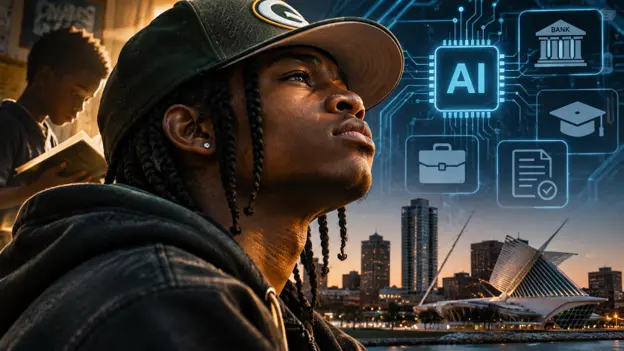
He wore a Green Bay Packers hat and sweater, with long braids. He wasn’t yelling or behaving inappropriately. He was simply trying to access his own money.
After leaving the bank, he called me again, frustrated. Sitting in his car, he noticed what he believed were police officers moving through the parking lot. He wondered whether they had been called because of him.
I couldn’t confirm his suspicions, but I understood why the possibility crossed his mind.
Eventually, we resolved the issue.
Afterward, I talked with him about navigating these encounters, including the unfortunate reality that wearing more conventionally respectable clothing might influence how he’s received when handling large financial transactions.
But I was uncomfortable giving that advice.
Because he had done absolutely nothing wrong.
He was a young Black entrepreneur trying to access his own money. Yet the burden of making the institution respond appropriately had fallen on him.
And increasingly, I worry that this problem is about to become much bigger.
As artificial intelligence becomes integrated into banking, education, healthcare, and employment, the ability to navigate institutions may depend even more on literacy, communication, and understanding complicated systems.
For Black men, this transition is particularly concerning.
Consider Milwaukee.
According to the 2024 National Assessment of Educational Progress, only 8% of Black eighth graders in Milwaukee scored at or above the NAEP Proficient level in reading. Across all racial groups, just 11% of Milwaukee’s eighth-grade boys reached that benchmark. These figures aren’t measures of basic literacy, but they reveal serious challenges in advanced reading comprehension.
Graduation statistics tell another troubling story.
According to Wisconsin’s Department of Public Instruction, 62.7% of Black Milwaukee Public Schools students graduated within four years in 2024, compared with 79.2% of white students. The district’s overall graduation rate improved to 72% for the class of 2025, an encouraging development, but substantial disparities remain.
And the challenges extend into employment.
According to the Bureau of Labor Statistics, the national unemployment rate for Black men ages 20–24 was 9.1% in the third quarter of 2026, compared with 6.8% for white men in the same age group. Among men ages 25–34, the gap was even wider: 7.4% for Black men compared with 4.1% for white men.
These statistics describe different populations, but together they raise an urgent question: What happens to young Black men already facing educational and employment barriers when artificial intelligence becomes another gatekeeper?
Imagine a young man trying to challenge a banking decision, complete a financial aid application, appeal an insurance denial, or navigate an automated hiring system.
What happens when he doesn’t understand the terminology? When he doesn’t know how to structure his request? When an automated system misinterprets his communication?
And what happens when there’s no human being available to intervene?
The next generation of inequality may not simply be about who has access to technology. It may be about who has the literacy and communication skills to make technology work for them.
As a child, I loved books.
I traveled the world through encyclopedias, novels, biographies, and historical accounts. The library became my pathway to the middle class.
I attended private Lutheran schools where I was challenged academically and developed reading, writing, and critical-thinking skills that continue to serve me as an educator and advocate.
Reading taught me more than how to process words. It taught me how to ask questions, recognize patterns, understand unfamiliar language, and challenge information that didn’t make sense.
Those are precisely the skills that will matter in an AI-driven economy.
And that’s what concerns me most.
The Black men and boys I care most deeply about are entering a world where the ability to communicate with machines, evaluate information, and navigate automated systems may increasingly shape their educational and economic opportunities.
Yet too many are leaving our schools without the reading proficiency and institutional knowledge necessary to compete on equal footing.
This isn’t about intelligence or ambition. It’s about whether our educational institutions are preparing young Black men for the world they’re entering.
We cannot repeat the mistakes of the digital divide, when access to devices was too often mistaken for meaningful technological education.
Our schools must prioritize reading comprehension, writing, critical thinking, and practical AI literacy. Our community organizations must teach young men how to navigate financial institutions, employment systems, and public services.
And institutions adopting AI must remain accountable for the barriers their technology creates.
Artificial intelligence could democratize knowledge and help young Black men overcome obstacles that once required professional assistance.
But that future isn’t guaranteed.
For most of my adult life, I’ve helped Black men navigate institutions that too often make them feel unwelcome, misunderstood, or powerless.
I don’t want the next generation spending their lives looking for someone like me to get a banker, administrator, or automated system to listen.
I want them to have the skills, knowledge, and confidence to advocate for themselves.
Because if AI is going to transform our society, we cannot allow it to become a more efficient way to leave Black men behind.
Sources
- National Assessment of Educational Progress (NAEP), 2024
Milwaukee Grade 8 Reading Snapshot Report
- Wisconsin Department of Public Instruction
Milwaukee Public Schools District Report Card, 2024–25
Official district report card (PDF)
- Milwaukee Public Schools, March 5, 2026
MPS Graduation Rate Grows to Highest Point in 15 Years
- U.S. Bureau of Labor Statistics
Table E-16: Unemployment Rates by Age, Sex, Race, and Hispanic or Latino Ethnicity

Robert "Biko" Baker III, Ph.D. (UCLA, History), works at the intersection of culture, tech, and public engagement. A former contributor to The Source and Vibe, he later served as national executive director of the League of Young Voters, leading high-profile civic campaigns and collaborations, including the launch of No Guns Allowed with Snoop Dogg and Ron Conway. He has advised and served on boards for organizations including CIRCLE at Tufts and Sankofa.org, and was named to the NAACP’s “40 Under 40.” Biko is currently Operations Manager for WNOV 860AM/106.5FM and the Milwaukee Courier Newspaper.